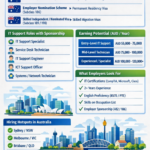
Visa Sponsorship & Earning Potential ($20.49–$25.30/hour)
Note: Salaries and opportunities can vary widely by city, employer, demand, and experience.
In this detailed guide, you’ll learn how international workers can find, apply for, and secure IT Support jobs in the U.S. with visa sponsorship, what the salary ranges look like (especially around $20.49–$25.30 per hour), and what steps you should take to boost your chances of success.
📌 1. Overview: IT Support Careers in the U.S.
Information Technology Support roles — such as IT Support Specialist, Help Desk Technician, Service Desk Analyst, or Technical Support Coordinator — are critical in almost every industry. These professionals help businesses and organizations keep their systems running and solve problems for end-users. Demand for IT support has remained steady as companies continue investing in digital infrastructure.
In many cases, foreign workers can be sponsored by U.S. employers if they possess the right skills and employers are willing to provide visa support.
🎯 2. Common IT Support Job Titles & Responsibilities
IT support jobs typically include the following roles:
🔹 IT Support Specialist
- Provide first-level hardware/software troubleshooting.
- Assist users via phone, email, or ticketing systems.
- Install or configure operating systems and applications.
- Document issues and resolutions for future reference.
🔹 Help Desk Technician
- Serve as the frontline for internal or external technical support.
- Resolve basic technical issues (network connectivity, software errors).
- Escalate complex issues to senior technicians.
🔹 Service Desk Analyst
- Monitor service requests and manage support queues.
- Communicate with vendors or IT teams for difficult problems.
- Often work in corporate environments supporting many users.
🔹 Technical Support Coordinator
- Coordinate support resources and ensure timely problem resolution.
- Communicate with other departments about IT policy changes.
- Assist in onboarding new staff with IT setup.
🇺🇸 3. Visa Sponsorship Options for International Workers
To work legally in the U.S., most foreign IT professionals require employer-sponsored work visas. Employers must file the appropriate petition on the worker’s behalf with U.S. Citizenship and Immigration Services (USCIS). Here are the most relevant U.S. visa categories for IT support workers:
🧑💻 H-1B Visa — Specialty Occupations
The H-1B visa is the most common work visa for skilled foreign professionals. Although it’s typically associated with higher technical or engineering roles, some IT support jobs can qualify if they meet the criteria of a specialized occupation — for example, when the role requires a bachelor’s degree or highly specialized IT skills.
- Requires a U.S. employer to file a petition.
- Valid up to 3 years, renewable once (total up to ~6 years).
- Annual cap: 65,000 visas + 20,000 for U.S. master’s degree holders.
Important (2026 update):
Some states, like Texas, have temporarily halted new H-1B petitions at state agencies and public universities amid policy review, though exceptions may be granted. This is part of a broader shift in federal and state approaches to visa hiring.
🔁 L-1 Visa — Intracompany Transfer
If you’re already employed by a multinational company with offices in the U.S., you might qualify for an L-1 transfer. This is common for IT professionals working in global organizations that need to relocate staff to U.S. teams.
- For employees in managerial, executive, or specialized knowledge roles.
- Can be valid for several years and lead to permanent residency.
⭐ O-1 Visa — Individuals with Extraordinary Ability
The O-1 visa is for individuals with exceptional skills or recognition in their field. This isn’t typically used for entry-level IT support, but experienced professionals with notable achievements (certifications, published work, awards) may qualify.
📍 Other Work Permits & Green Cards
Some international workers enter on student visas with OPT/CPT and later transition to H-1B sponsorship. Permanent residency options (EB-2/EB-3) may also be available via employer-sponsored green card processes — though these take longer.
💰 4. Salary Expectations — IT Support in the USA (2026)
Salary levels in the U.S. vary by location, employer size, demand, and experience. Many entry-level roles fall into the $20.49–$25.30 per hour range, which roughly translates to $43,000–$52,000 annually, depending on full-time hours, overtime, and benefits.
💵 Typical Hourly Rates for IT Support Roles
- Entry-level IT Support: ~$20.49–$24.50/hour
- Standard IT Support / Technician: ~$24.49–$26.30/hour
- Higher paid roles (experienced or in high-cost cities): ~$26–$30+/hour.
📊 What This Means Annually
Assuming full-time 40-hour weeks:
- $20.49/hr ≈ $42,600/year
- $25.30/hr ≈ $52,600/year
- With overtime or in major tech hubs (e.g., San Francisco or New York), total compensation often exceeds these figures.
💎 Benefits Employers Often Provide
Many U.S. employers include benefits that add real value to compensation:
- Health and dental insurance
- 401(k) retirement plans
- Paid time off (PTO)
- Professional development or certification subsidies
- Relocation assistance
These perks significantly improve total compensation beyond hourly wages.
🧠 5. Skills, Qualifications & Certifications
To compete for visa-sponsored IT support jobs, it’s essential to showcase both technical skills and workplace readiness. Here’s what employers look for:
📌 Core Technical Skills
- Troubleshooting hardware and software.
- Familiarity with Windows, macOS, and basic Linux systems.
- Networking basics (TCP/IP, DHCP, DNS).
- Experience with help desk ticketing systems.
📚 High-Value Certifications
Certifications demonstrate readiness and can strengthen visa sponsorship applications:
- CompTIA A+ – foundational support certification.
- Microsoft Certified: Modern Desktop Administrator Associate
- Cisco CCNA (for roles involving networking basics).
- ITIL Foundation (for service support processes).
📢 Soft Skills
- Excellent communication and customer service abilities.
- Patience and clear explanation skills for non-technical users.
- Ability to work under pressure in fast-paced environments.
🏙️ 6. Hiring Hotspots in the USA
Certain U.S. regions consistently offer more IT support positions, often with better pay and sponsorship potential:
🌉 West Coast
- Silicon Valley / San Francisco Area
- Seattle (Microsoft, Amazon, tech clusters)
Often above-average wages, strong demand for IT roles.
🗽 East Coast
- New York City
- Boston & Cambridge
Large corporate, finance, and healthcare employers needing support technicians.
🌆 Other Growing Regions
- Austin, Texas
- Denver, Colorado
- Chicago, Illinois
Tech hubs with many multinational firms and competitive compensation.
🧭 7. Where to Find Visa Sponsorship Jobs
Use a combination of job boards, networking, and direct employer outreach:
🔍 Major Job Boards
- LinkedIn Jobs – filter keywords like “visa sponsorship available.”
- Indeed.com – search for “IT support visa sponsorship.”
- Glassdoor – company reviews and salary insights.
- MyVisaJobs.com – employer sponsorship data.
🧑💼 Company Career Pages
Large companies that historically sponsor international talent include:
- Tech giants
- Financial firms
- Healthcare systems
- Government contractors
These often list visa support information directly.
👥 Networking
- Professional meetups or tech networking events.
- Online communities (e.g., GitHub, tech Slack groups).
- LinkedIn outreach to HR recruiters specializing in global talent.
📑 8. How to Apply: Best Practices
To improve your chances of landing a sponsorship role:
✅ Optimize Your Resume
- Use U.S. resume standards (clean format, bullet lists, measurable achievements).
- Highlight technical skills and certifications.
✉️ Tailor Your Cover Letter
- Customize for each job.
- Explain why you’re a strong fit and can contribute from day one.
💼 Prepare for Interviews
- Expect technical questions about troubleshooting.
- Be ready for behavioral questions on teamwork and user service.
📌 Highlight Visa Readiness
- Mention your willingness or need for sponsorship.
- Clarify eligibility status in cover letters or applications where appropriate.
🎓 9. Pathways to Career Progression
An IT support job in the U.S. can be a stepping stone to advanced IT roles. Once in the country, consider:
✔ Gaining Experience
Build track record in intermediate or senior support roles.
✔ Specializing
Move toward network administration, cloud support, cybersecurity.
✔ Further Education
U.S. certifications or degrees can boost employability.
✔ Permanent Residency
Some employers sponsor green cards after a period of employment.
⚠️ 10. Key Challenges for International Workers
🧾 Visa Caps & Processing
The H-1B visa is capped annually, and changes in regulation (such as increased fees or state freezes) can affect processing timelines.
🏆 Competitive Market
Entry-level roles often attract both domestic and international eligible workers.
🏡 Cost of Living
In major cities, hourly wages may be offset by high housing and living costs.
📌 Final Thoughts
IT support jobs offering visa sponsorship in the U.S. remain a viable path for international tech workers, especially with the right preparation, skills, and strategy. Earning between $20.49 and $25.30 per hour is common for entry and mid-level roles in 2026, with additional benefits often enhancing total compensation.
Focus on building strong technical skills, earning certifications, and targeting employers with a history of sponsoring foreign talent. With persistence and strategic job searching, you can build a rewarding IT career in the U.S.