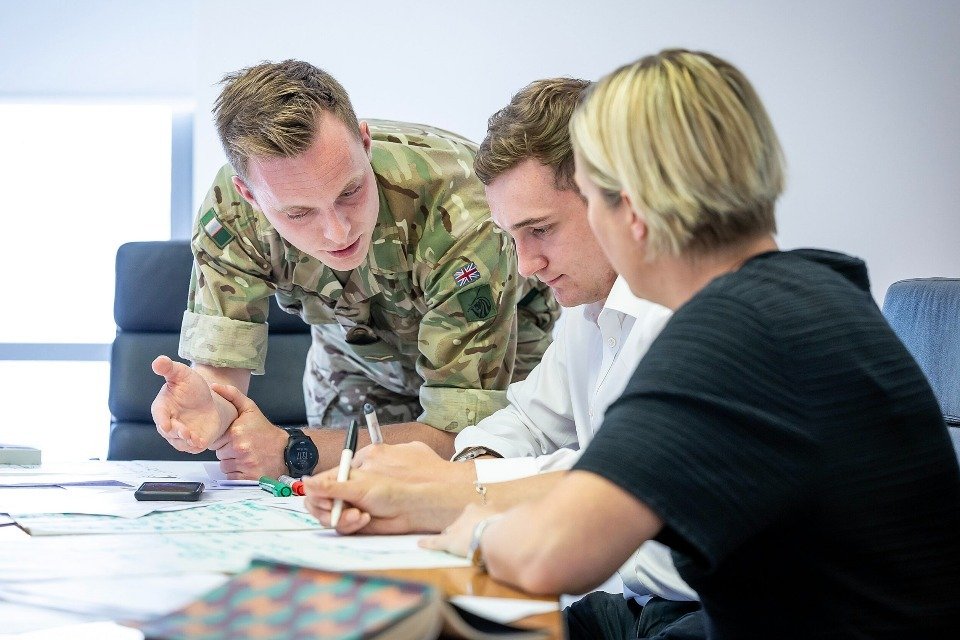
The United Kingdom’s Ministry of Defence (MOD) is one of the largest and most complex government institutions in the world, responsible for ensuring the defence, security, and resilience of the nation. While the British Armed Forces—Army, Royal Navy, and Royal Air Force—form the front-line defence capability, the MOD heavily relies on a vast civilian workforce to support its operations. What many foreign professionals do not know is that the MOD also employs international talent and, for certain roles, may allow organisations under its structure to sponsor skilled foreign workers under the UK visa system.
This guide explores in depth the nature of MOD civilian roles, how sponsorship works, the pathways available to foreign professionals, eligibility requirements, benefits, and how to apply.
1. Understanding MOD Civilian Employment
The Ministry of Defence is not merely a military institution. It is also a massive civilian employer, with more than 55,000 civilian staff working in various fields including:
- Engineering
- Cybersecurity
- Procurement and logistics
- Science & research
- Health and medical roles
- Business, management, and finance
- IT and digital services
- Infrastructure and estate management
- Intelligence support roles
- Administrative and corporate functions
Civilian employees typically work within the MOD itself, or within its agencies, including:
- Defence Equipment and Support (DE&S)
- Defence Science and Technology Laboratory (Dstl)
- UK Strategic Command
- Defence Infrastructure Organisation (DIO)
- Submarine Delivery Agency (SDA)
- RAF, Army, and Navy Civilian Offices
Because many of these areas require advanced, technical, or scarce skills, the MOD collaborates with UK Home Office immigration rules to allow organisations under its umbrella to sponsor foreign workers under certain visa categories.
2. What Are MOD Civilian Sponsorship Roles?
MOD civilian sponsorship roles refer to positions within Ministry of Defence departments, agencies, or partner organisations where:
- A job is listed as eligible for the UK Skilled Worker Visa, and
- The employer is a Home Office–licensed sponsor, and
- The role requires skills difficult to source domestically, or is part of a specialist defence capability.
In these cases, the employer may issue a Certificate of Sponsorship (CoS) enabling an overseas applicant to apply for a Skilled Worker Visa.
There are typically three categories of MOD-affiliated organisations eligible to sponsor international candidates:
A. MOD Agencies That Are Licensed Sponsors
These include defence-related scientific, engineering, or infrastructure organisations that regularly hire foreign technical talent. Examples may include DE&S, Dstl, or the Submarine Delivery Agency, depending on time and licensing status.
B. Defence Contractors and Defence Industry Companies
Thousands of civilian staff work indirectly for the MOD through partners like:
- BAE Systems
- Rolls-Royce Defence
- Babcock International
- Airbus Defence & Space
- MBDA UK
- Leonardo UK
- Thales Group
These companies—which often hold sponsorship licences—supply the MOD with engineering support, cybersecurity services, shipbuilding, aerospace engineering, and logistics support.
C. MOD-Approved Research & Intelligence Organisations
Specialist research facilities and labs sometimes recruit international scientists, engineers, and analysts on specialist visas.
Not all MOD roles are open to foreign nationals due to security restrictions, but many technical and civilian roles do not require UK citizenship and are available to international workers.
3. Why MOD Civilian Roles Are Important
Civilian staff play an essential role in supporting the UK’s defence operations, often providing expertise that uniformed officers cannot offer. Their contributions include:
a. Engineering and Technology Support
The UK military relies on high-tech equipment such as submarines, fighter jets, drones, radar systems, and cyber defence platforms. Civilian engineers maintain and develop these systems.
b. Digital and Cyber Defence
As modern warfare evolves, the MOD invests heavily in digital capabilities, artificial intelligence, data science, and cybersecurity. Civilian experts provide much of this support.
c. Procurement & Supply Chain Management
The MOD runs one of the UK’s largest procurement systems. Civilian procurement officers ensure the Armed Forces receive the right equipment, vehicles, and technology.
d. Scientific Research
Research into advanced weaponry, communications, robotics, and chemical/biological defence often relies on civilian scientists.
e. Health & Welfare Services
Doctors, nurses, psychologists, and rehabilitation specialists work with military personnel and veterans.
f. Policy & Administration
Civilian professionals shape defence policy, budgeting, HR, communications, and international defence relations.
Because these roles require specialised skills, sponsorship becomes essential when domestic talent is limited.
4. Types of MOD Civilian Roles That May Offer Visa Sponsorship
Below are common categories of MOD-affiliated civilian roles that may be eligible for sponsorship:
1. Engineering Roles
- Aerospace engineers
- Mechanical engineers
- Electrical and electronics engineers
- Nuclear engineers
- Marine and naval engineers
- Weapons and systems engineers
- Structural and civil engineers
The defence sector depends heavily on engineering talent.
2. IT & Cybersecurity Roles
- Cyber defence analysts
- Penetration testers
- IT security specialists
- Network engineers
- Cloud engineers
- Systems administrators
- Software developers
- Data analysts
- AI and machine learning specialists
Cybersecurity roles are among the most in-demand.
3. Scientific Research Roles
Typically found in Dstl and defence research institutes:
- Physicists
- Chemists
- Biologists
- Research engineers
- Lab technicians
- AI scientists
- Robotics experts
4. Health & Medical Roles
The MOD hires medical professionals to support military hospitals, rehabilitation centres, and research programmes:
- Doctors
- Physiotherapists
- Psychologists
- Radiographers
- Lab scientists
- Occupational therapists
Many of these fall under the Health and Care Visa route.
5. Logistics & Supply Chain
- Procurement officers
- Warehouse managers
- Logistics planners
- Transport coordinators
6. Project and Programme Management
MOD projects are large, complex, and require professional managers from abroad when skills are scarce.
7. Infrastructure & Estate Management
Through the Defence Infrastructure Organisation:
- Surveyors
- Construction managers
- Civil engineers
- Architects
- Quantity surveyors
Many of these fall under Skilled Worker occupations.
8. Administrative and Corporate Roles
While not all administrative roles are eligible for sponsorship, senior or specialist ones may be.
5. Visa Pathways for MOD Civilian Sponsorship
There are three main visa categories through which MOD civilian roles can be sponsored:
1. Skilled Worker Visa
This is the primary visa for MOD civilian employees. Requirements include:
- A job offer from a licensed sponsor
- A Certificate of Sponsorship
- Eligible occupation and skill level
- English language proficiency
- Proof of salary meeting minimum thresholds
2. Health and Care Worker Visa
For healthcare professionals working with military medical services.
3. Global Talent Visa (for researchers and scientists)
Researchers working at recognised defence research institutions may qualify without needing employer sponsorship.
4. Global Business Mobility – Specialist Worker Visa
For international companies collaborating with the MOD through defence contracting.
6. Eligibility Criteria for International Applicants
To be hired into an MOD civilian role with visa sponsorship, an international applicant must:
1. Meet the professional requirements
This usually includes:
- A relevant degree or qualification
- Technical or professional experience
- Security clearance eligibility
2. Pass Security Checks
Not all roles require high-level clearance. Many civilian positions only require basic or standard checks.
Foreign nationals are eligible for:
- Baseline Personnel Security Standard (BPSS)
- Security Check (SC) in some circumstances
- Developed Vetting (DV) only in limited cases
Nationality restrictions apply mainly to intelligence and sensitive military roles.
3. Meet visa requirements
Including English proficiency and salary thresholds.
7. Benefits of Working as an MOD Civilian Employee
Working for the UK Ministry of Defence offers a wide range of advantages:
a. Job Stability and Security
Government roles provide long-term career stability.
b. Competitive Salary
Engineering, cybersecurity, and scientific roles often come with high pay, sometimes exceeding £50,000–£90,000 annually.
c. Pension Benefits
The Civil Service Pension Scheme is one of the best in the UK.
d. Work-Life Balance
The MOD encourages flexible and hybrid working.
e. Professional Development
Employees benefit from:
- Funded training
- Certifications
- Leadership programs
- Opportunities for promotion
f. Cutting-Edge Technology
Many MOD departments work with advanced defence technology.
g. Societal Impact
Supporting defence helps protect national security.
h. Pathway to Settlement
Skilled Worker and Health & Care Visas lead to Indefinite Leave to Remain (ILR) after 5 years.
8. How to Apply for MOD Civilian Sponsorship Roles
Step 1: Search for MOD Jobs
MOD-affiliated roles are advertised on:
- Civil Service Jobs portal
- Defence industry company websites
- UK defence recruitment websites
Search keywords such as:
- “MOD”
- “Defence”
- “Sponsorship available”
- “Skilled Worker Visa”
Step 2: Identify if Sponsorship Is Available
Not all job postings mention sponsorship. Look for terms like:
- “Visa sponsorship available”
- “Skilled Worker Visa eligible”
- “Home Office licensed sponsor”
Step 3: Tailor Your CV
Highlight:
- Technical skills
- Defence-related experience
- Engineering or cybersecurity expertise
- Research publications
Step 4: Prepare for Security Eligibility Questions
Expect questions about past travel, nationality, and residency.
Step 5: Interview Stage
MOD interviews are structured and competency-based.
Step 6: Sponsorship and Visa Application
If selected:
- The employer issues a Certificate of Sponsorship
- You apply for your visa
- Attend biometrics appointment
- Receive your visa decision
9. Challenges and Limitations
While MOD civilian sponsorship roles exist, there are certain limitations:
1. Security Clearance Restrictions
Not all roles are open to foreign nationals due to the sensitive nature of defence work.
2. Competition
Defence roles attract many applicants globally.
3. Long Recruitment Processes
Security checks can extend hiring timelines.
4. Sponsorship Availability Varies
Not all MOD agencies offer sponsorship every year.
Despite these challenges, thousands of international professionals work successfully in UK defence roles.
10. Best Countries Whose Citizens Often Work in MOD Civilian Roles
Candidates from the following countries often apply because of strong engineering, tech, and scientific backgrounds:
- India
- Nigeria
- Pakistan
- South Africa
- United States
- Canada
- Germany
- Australia
- Philippines
Nationality is not a barrier unless the role requires high-level security clearance.
11. Frequently Asked Questions
Q1: Can foreigners work for the UK MOD?
Yes, foreigners can work in many civilian roles, especially in technical, scientific, health, and engineering fields.
Q2: Does the MOD directly sponsor visas?
Some MOD agencies may have licences, but most sponsorship occurs through MOD-affiliated defence contractors and partner organisations.
Q3: Are civilian roles easier to access compared to military roles?
Yes. Foreign nationals cannot join the Armed Forces unless they meet residency rules, but civilian roles are far more accessible.
Q4: Do MOD roles lead to permanent residency?
Yes, Skilled Worker and Health & Care visas allow settlement after 5 years.
Conclusion
MOD civilian sponsorship roles offer valuable opportunities for international professionals who want to work in one of the UK’s most strategic, well-funded, and technologically advanced sectors. From engineering and cybersecurity to healthcare and scientific research, there are multiple pathways through which foreign nationals can contribute to the nation’s defence while building rewarding careers.
These roles combine meaningful work with excellent salaries, professional development, job stability, and a clear path to settlement in the UK. Although not all positions are open to non-UK citizens, thousands of roles across defence agencies and partner companies welcome international talent and provide Skilled Worker Visa sponsorship.